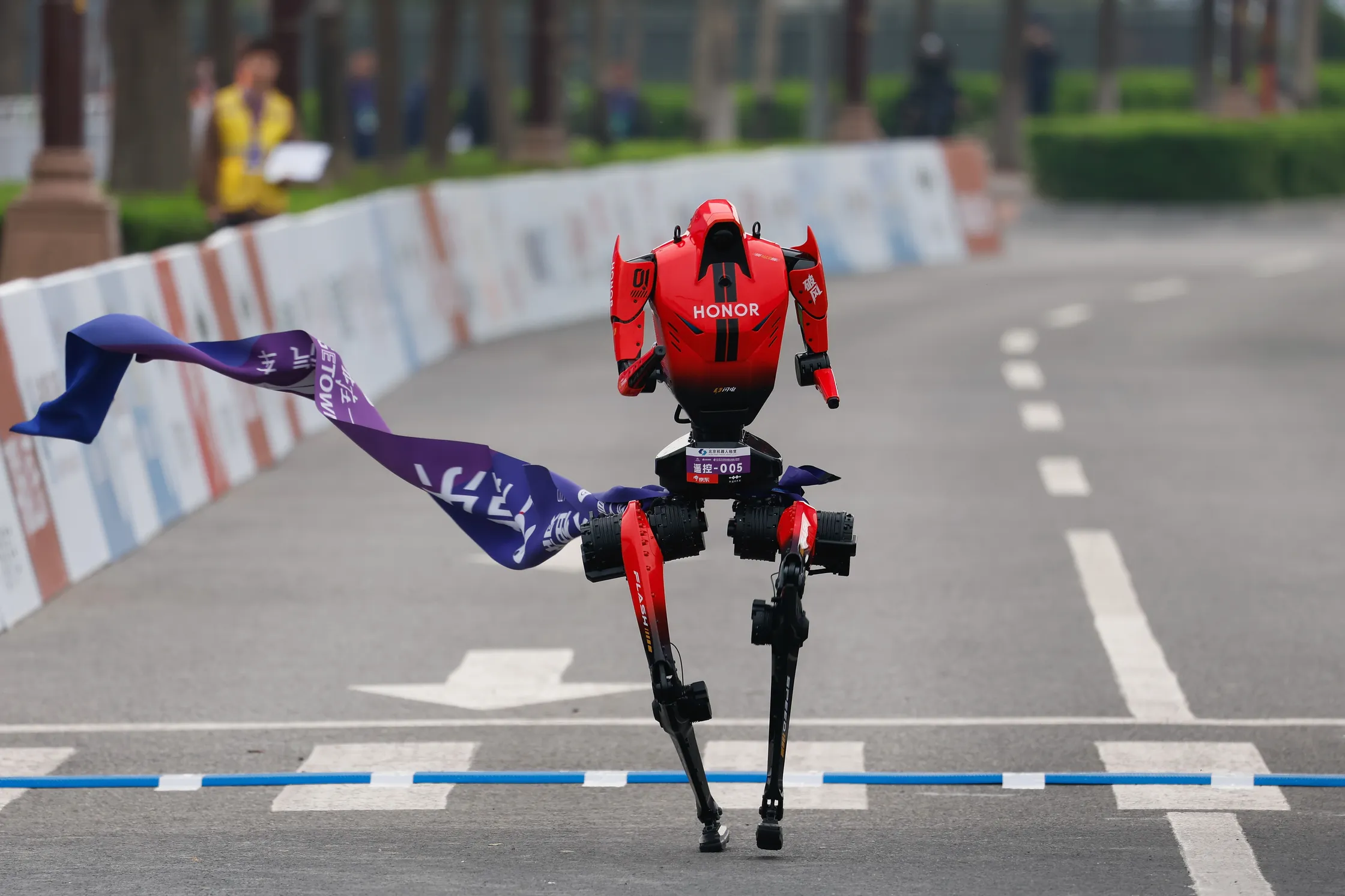
In a moment that feels closer to science fiction than sport, a humanoid robot has set a new half-marathon record in China — finishing the 21.1 km race in 50 minutes and 26 seconds.
Developed by the Chinese technology company Honor, the autonomous robot didn’t just complete the race — it outperformed the existing human benchmark by a full seven minutes, marking a significant milestone in the evolution of robotics and artificial intelligence.
More Than a Race
This wasn’t simply about speed.
The robot operated fully autonomously, navigating the course without human intervention, maintaining pace, balance, and endurance across the entire distance. Unlike controlled lab environments, long-distance running introduces variables such as terrain variation, energy management, and mechanical stress — all of which the system handled in real time.
The result signals a shift from robotics designed for isolated tasks to machines capable of sustained, real-world physical performance.
Engineering Endurance
Running a half marathon is as much about efficiency as it is about power.
To achieve this, the robot integrates advanced motion control systems, AI-driven gait optimization, and real-time energy distribution — allowing it to maintain consistent speed without the fatigue limitations of human athletes.
Unlike humans, it doesn’t slow down due to lactic acid buildup or muscle exhaustion. Instead, its constraints are mechanical: battery capacity, heat regulation, and system durability.
A Glimpse Into the Future of Robotics
While record-breaking headlines capture attention, the broader implications go far beyond sport.
Humanoid robots capable of sustained physical activity could reshape industries ranging from logistics and manufacturing to emergency response and infrastructure maintenance. The ability to operate continuously, without rest, introduces a new benchmark for productivity and performance.
At the same time, this development raises deeper questions about the evolving relationship between humans and machines — particularly in domains once defined by human endurance and physical limits.
Redefining Limits
For decades, robotics has focused on precision and repetition.
Now, it’s entering a new phase: endurance.
And if a humanoid robot can outrun elite human performance over long distances, the definition of “peak performance” may no longer belong exclusively to humans.

Passionate about journalism and media, I am committed to producing content that is not only informative and engaging but also drives social change. I advocate for women’s empowerment and gender equality, mentoring aspiring female journalists and media professionals. My approach is rooted in creativity, collaboration, and a relentless pursuit of excellence, ensuring that every project I undertake achieves its maximum potential.